5-Min Brief: Only 18% of the World Uses AI. The US Ranks 21st. And Software Jobs Are at a Record High.
What you need to know — in 30 seconds
- Microsoft published its Global AI Diffusion Report this week tracking real-world AI adoption across 160 countries
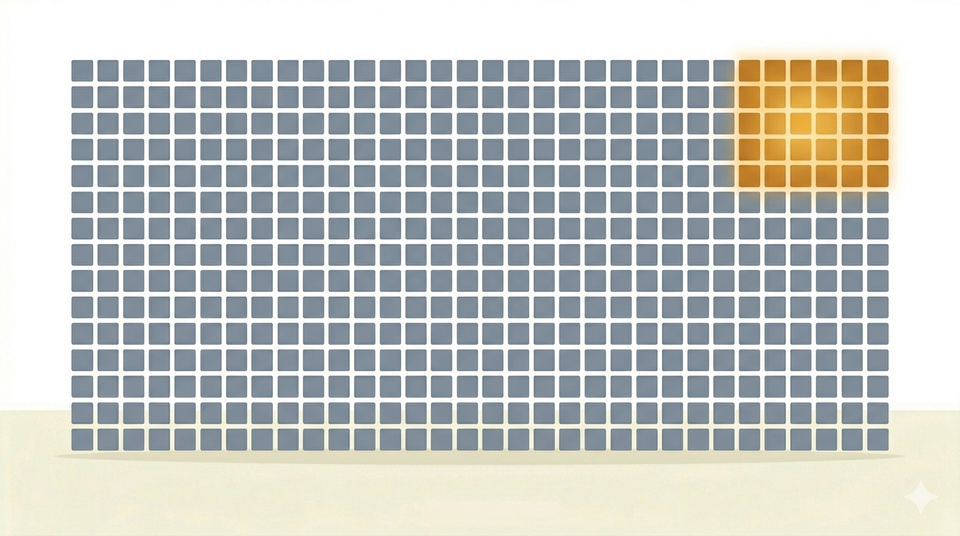
- Only 17.8% of the world's working-age population uses AI — meaning more than 80% of people haven't adopted it yet
- The US ranks just 21st globally in AI adoption, at 31.3% of working-age adults
- Despite all the headlines about AI replacing software developers, US software developer employment just hit a record high
We've spent the past few weeks covering AI from the top down — the billions being invested, the companies cutting jobs, the world leaders preparing to talk about it. Today let's flip the lens and look at what's actually happening on the ground: who is using AI, where, and how much.
Microsoft published its Global AI Diffusion Report this week, tracking real usage data from across 160 countries. It's one of the most grounded datasets on AI adoption available — not surveys asking people if they plan to use AI, but actual usage telemetry showing whether they are. The findings cut against almost every assumption you might have.
Most of the world hasn't adopted AI yet
Here's the number that reframes everything: only 17.8% of the world's working-age population — people aged 15 to 64 — used AI in the first quarter of 2026.
That means more than four out of five people on earth are not using AI tools in any meaningful way. The technology that dominates every business headline, every investment thesis, every policy debate — the majority of the world hasn't touched it yet.
That's not necessarily bad news. It could mean there's an enormous amount of growth still ahead. During Q1 2026 alone, AI usage increased by 1.5 percentage points, from 16.3% to 17.8% of the world's working-age population. That's a meaningful jump in three months. But it's a useful corrective to the sense that AI has already transformed everything.
The US is not leading where it counts
This one might surprise you. The United States finally started to move up the national AI adoption rankings, but only from 24th to 21st, based on a 31.3% usage rate among the working-age population.
21st in the world. For a country that dominates AI development, invests more in AI infrastructure than anyone else, and generates most of the AI headlines, that ranking is striking.
Who's ahead? The UAE leads global AI diffusion at 70.1% — more than double the US rate. Nordic countries, Singapore, and several Asian economies all outrank the US on actual adoption.
The gap between building AI and using AI turns out to be significant. The US is winning the race to develop frontier models. It's not winning the race to get regular people actually using them in their daily work.
Notable developments in Q1 included accelerating AI adoption in Asia, driven in part by improving AI capabilities in Asian languages. South Korea, Thailand, and Japan saw the greatest movement. As AI gets better at languages other than English, adoption in non-English-speaking countries is starting to accelerate. That's a meaningful shift in who this technology is actually serving.
The software jobs data will surprise you
We've spent a lot of time recently covering the narrative that AI is replacing software developers — Google writing 75% of its code with AI, companies cutting engineering headcount, the Stanford AI Index showing employment for young developers falling.
The Microsoft report adds an important counterpoint.
In 2025, total US software developer employment reached approximately 2.2 million, rising 8.5% year over year and marking a record high for the profession. Early data for Q1 2026 shows that software developer employment in March 2026 was about 4% higher than in March 2025.
Record high. Up 8.5% in one year. That's not the picture you'd paint if AI was straightforwardly replacing developers.
What's likely happening is more nuanced than either the "AI is replacing everyone" or "nothing to worry about" camps suggest. AI tools are making individual developers significantly more productive — which means the same number of developers can build more. But demand for software is also growing dramatically, driven in part by the AI buildout itself. More software is being built. Each developer can build more of it. The net result, so far, is more developer jobs, not fewer.
Whether that continues as AI capabilities keep improving is the genuine open question. The report notes it is still too early to know the full labor-market impact of AI-assisted coding. That's an honest caveat worth holding onto.
The digital divide is widening
One finding in the report that deserves more attention than it's getting: the gap between the Global North and South is continuing to widen, with AI usage now at 27.5% in the North and 15.4% in the South.
AI adoption is accelerating in wealthy countries and lagging significantly in developing ones. That matters because AI is increasingly a productivity tool — the people and countries using it are getting things done faster, more efficiently, and at lower cost. If that advantage compounds over years and decades, the AI divide could become as consequential as the internet divide, or worse.
The countries falling behind on AI adoption today may find themselves at a structural disadvantage in ways that are hard to reverse later.
What this all means
The AI story in 2026 is not "AI has transformed everything." It's "AI is transforming things fast in a relatively small number of places, while most of the world is still on the sidelines."
That's actually a more interesting story than the one usually told. It means the transformation is just getting started. It means the biggest impacts — positive and negative — are still ahead. And it means the decisions being made right now about how AI gets built, governed, and distributed will shape whether the benefits end up broadly shared or concentrated among the countries and companies already at the front of the line.
HumanReadable-AI covers AI news in plain English every weekday. Subscribe below — free, no jargon, always under five minutes.